Introduction
MIT's 2025 State of AI in Business report revealed a surprising result. Ninety-five percent of enterprise AI initiatives deliver no measurable value. Only a small minority, about five percent, are achieving real operational gains. MIT calls this split the GenAI Divide.
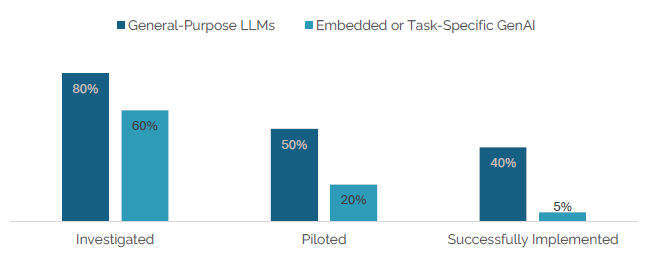
Even though many organizations have adopted tools like ChatGPT or Copilot, most still struggle to integrate AI into the workflows that actually run the business. MIT identifies one central reason for this:
Most AI systems do not learn. They do not remember, adapt, or improve.
This is the structural gap that Kacti was designed to solve.
The Learning Gap Behind AI Failure
MIT's research shows that the top barrier to successful AI adoption is not model quality or regulation. The main issue is the lack of learning capability. AI tools are unable to retain context, evolve with real workflows, or improve from feedback.
MIT highlights three specific problems:
AI tools forget everything
Large language models require full context every time. They cannot accumulate knowledge across days or projects.
AI tools do not fit real workflows
Enterprise processes change often, and static AI systems break with even small variations.
AI tools do not improve with use
Users repeat the same corrections because the system has no mechanism to learn from operational behavior.
MIT summarizes this clearly: most AI tools do not adapt, remember, or evolve, and this is what separates organizations that succeed from those that stall.
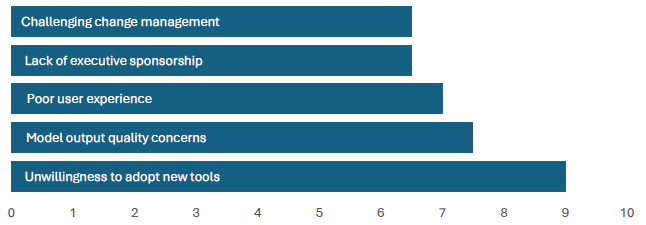
Users were asked to rate each issue on a scale of 1-10
Why ChatGPT Wins and Still Loses
MIT found that employees prefer ChatGPT or Claude for daily tasks because these tools feel fast, flexible, and intuitive. Users often trust the output more than the output of enterprise AI systems.
However, when the work becomes sensitive or high-stakes, people choose humans over AI almost every time. Close to ninety percent prefer a human colleague for complex or multi-week tasks.
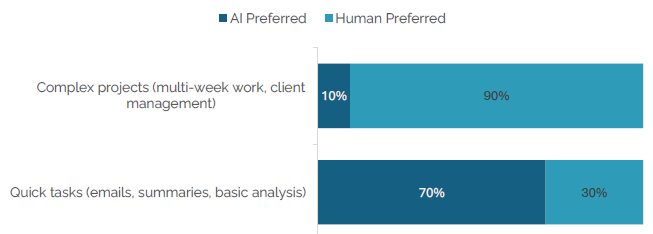
"Would you assign this task to AI or a junior colleague?"
Consumer tools show clear limitations. They do not retain memory, cannot follow evolving preferences, and require the user to restate context constantly.
MIT calls this the "learning gap," and it explains why AI helps individuals but fails to transform organizations.
What the Top Five Percent Do Differently
MIT studied the small set of companies that crossed the GenAI Divide. These organizations succeed because they adopt systems that:
- ✓ Integrate with workflows
- ✓ Retain memory
- ✓ Adapt to feedback
- ✓ Improve continuously
- ✓ Evolve as the business changes
They avoid generic AI features and brittle internal builds. Instead, they prioritize platforms designed around semantics, learning, and operational fit. These patterns are directly aligned with how Kacti operates.
"What's missing is systems that adapt, remember, and evolve."
How Kacti Closes the Learning Gap
Kacti was created to address the exact issues highlighted in the MIT report. Instead of adding AI to existing ERP systems, Kacti introduces an AI-native architecture that learns from execution.
The Semantic Compiler
You describe a process in plain language. Kacti converts that description into an executable business blueprint that is reliable, structured, and explainable.
The Pattern Network
Each workflow strengthens the pattern network. Successful paths become clearer, recurring issues are corrected sooner, and exceptions shrink over time. This creates the foundation for continuous improvement that separates successful AI implementations from those that fail.
If you're leading AI or operations initiatives and want to compare notes on building AI-native systems, I'd love to connect.
You can grab a time in my calendar here: Talk to founder